
The VBA Model
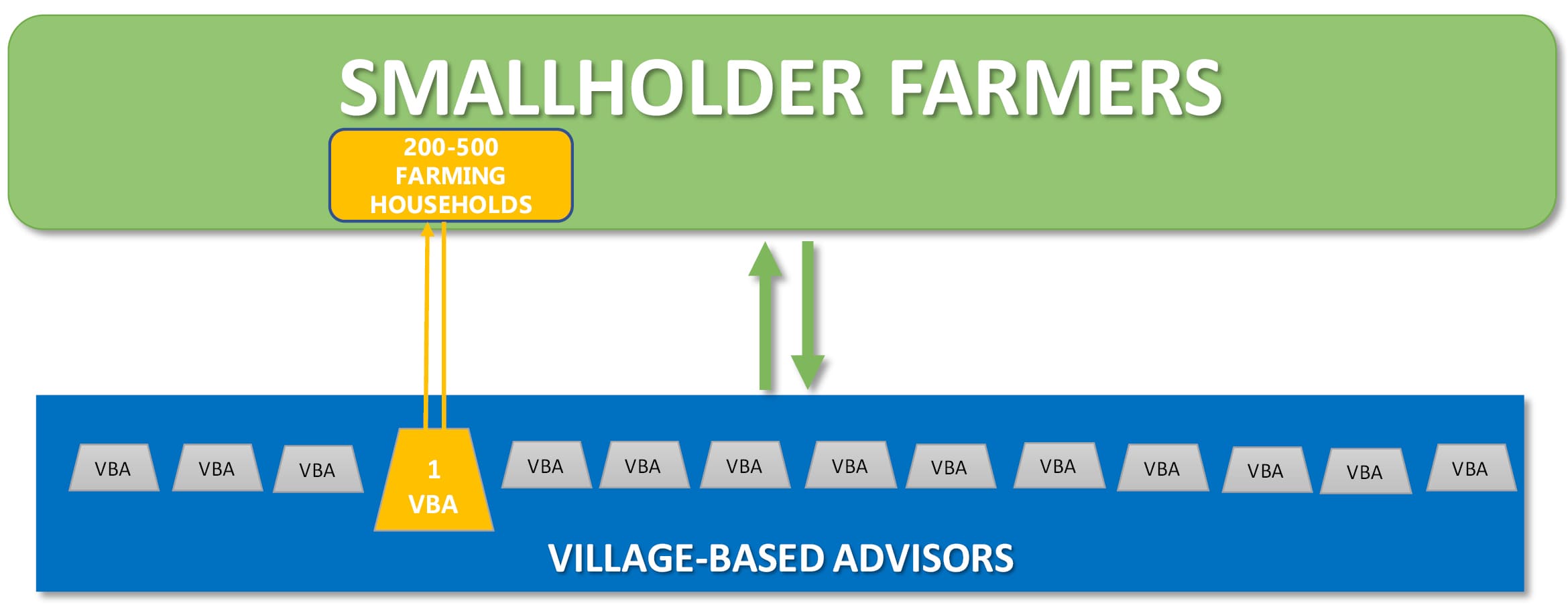
FIPS-Africa encourages the use of climate-smart technologies proven to be beneficial to smallholder farmers. Through a network of village-based advisors (VBAs) we offer training and options to farm inputs and services.
The approach is inclusive, training all farmers in the villages – including women farmers and low-income farming families. The village-based advisors gain commission from the sale of goods and services – which helps to make this delivery model sustainable. FIPS-Africa devised the idea of village-based advisors (VBA) as essential way of linking small-holder farmers to advice, inputs, farm services and output markets.
The approach has a number of key elements. First, communities choose a trusted farmer to act as the village- based advisor. The VBA is trained in a portfolio of agricultural technologies that have been preselected as having high potential in the area. Depending on the size and spread of farms VBAs can support between 50 and 200 farming households. The VBAs have a distinct way of getting new technologies out to farmers. Instead of the conventional demo plot, the VBAs create a small demo on their farms, and then distribute
small seed packs to the whole village. The smallholder farmers grow the new seed varieties alongside their traditional varieties.
They can then compare the The beauty of the VBA advice and market access being brought to the farm gates means that there are few barriers to prevent women and young people accessing the services. Meetings and remote demo sites are often inaccessible to women and training is dominated by older more established farmers. FIPS-Africa devised the idea of village-based advisors (VBA) as essential way of linking small-holder farmers to advice, inputs, farm services and
output markets. The approach has a number of key elements. First communities choose a trusted farmer to act as the village-based advisor. The VBA is trained in a portfolio of agricultural technologies that have been preselected as having high potential in the area. Depending on the size and spread of farms VBAs can support between 50 and 200 farming
households.
How VBAs Provide Farming Technology to Farmers
The VBAs have a distinct way of getting new technologies out to farmers. Instead of the conventional demo plot, the VBAs create a small demo on their farms, and then distribute small seed packs to the whole village. The smallholder farmers grow the new seed varieties alongside their traditional varieties. They can then compare the The beauty of the VBA advice and market access being brought to the farm gates means that there are few barriers to prevent women and young people accessing the services. Meetings and remote demo sites are often inaccessible to women and training is dominated
by older more established farmers.
FIPS-Africa treats the VBA model as an international public good, because it is
So critical to the successful the transformation of extension services and widening access to input and output marketing by smallholder farmers. Organisations in many sub-Saharan countries are now delivering the VBA model on their own. Others however work directly with FIPS to benefit from their 20 years of action research and the implicit knowledge which continues to shape and improve the core VBA model.
VBA Model Spread Across Africa
The VBA model is spreading across Africa. When Seed Systems Group wanted to regenerate seeds systems across Africa it looked to FIPS to help build a VBA system in some of its priority countries, (including Burundi, Eritrea, Djibouti, DR Congo, Madagascar, Somalia, South Sudan, Senegal and Togo). The VBAs have reach 425,000 farmers sharing information on good agricultural practices, and distributing over 600,000 small packs.
The FIPS approach has also been picked up by others. AGRA sees the VBA as powerful way of ensuring that smallholder farmers are better able to access first and last mile extension, and access to farmers services and input and output markets. Over the passed ten years AGRA has trained 32,000 VBAs in their priority countries.